AI Chatbots' Accuracy Quandary

Introduction
AI-powered language model chatbots offer a range of potential benefits across various domains. These systems can provide instant, 24/7 access to information and assistance, scaling to serve large numbers of users simultaneously. They have the capacity to understand and respond to queries in natural language, making them accessible to a wide audience. The breadth of knowledge these models can encompass allows them to assist with diverse topics, from academic research to creative writing to technical troubleshooting. In professional settings, they may boost productivity by automating routine communication tasks and providing quick answers to common questions. For education, they can offer personalised tutoring and explanations tailored to individual learning styles. In healthcare, they might aid in preliminary symptom assessment or provide mental health support.
However, it's important to note that while these benefits are often assumed or anticipated, the actual impact and effectiveness of AI chatbots can vary depending on their specific implementation, training, and the context in which they're used. Ongoing research and real-world testing are necessary to fully understand their capabilities and limitations. As a matter of fact, over the past 12 months, WorkN'Play has been researching chatbots' ability to mimic specific human abilities and behaviours. What is the extent of their Linguistic Proficiency, Verbal Reasoning, Rational Thinking, and Numerical Ability ? How does the top of mid chatbot ChatGPT stack up against Replika, Claude, HuggingChat, Co-Pilot, and Gemini ? Thus far, our research has concluded that chatbots can guarantee an overall 60% accuracy when answering questions.
Claude demonstrates impressive overall performance and growth. It achieved the highest overall accuracy rate of 75.0% among all the chatbots listed. This puts it ahead of well-known models like ChatGPT-3.5 (72.5%) and ChatGPT-4o (70.0%), as well as significantly outperforming others like Gemini and HuggingChat (both at 52.5%). Claude's superior accuracy suggests a robust and well-rounded capability across various skill sets. Furthermore, Claude also showed the highest rate of improvement over a 12-month period, with a 5.1% increase in performance. This growth rate outpaces that of its closest competitors, ChatGPT-3.5 (4.3%) and Co-Pilot (2.2%). The combination of Claude's top accuracy score and leading growth rate indicates not only current excellence but also a strong trajectory for future improvements. This data suggests that Claude is at the forefront of AI language model development, consistently delivering high-quality results while also rapidly evolving its capabilities.
However, the handling of the overall 40% margin of error is the main challenge for users. This high rate of inaccuracy underscores the need for users to approach chatbot interactions with a critical mindset. Users must learn to balance the convenience and accessibility of chatbots with a healthy skepticism towards the information provided. Developing this critical perspective requires educating users on the limitations of AI technology, encouraging fact-checking habits, and promoting an understanding of the importance of verifying information from multiple sources. Additionally, users should be trained to recognise when a topic requires expert knowledge and to seek human expertise in such cases. Chatbot developers and providers have a responsibility to clearly communicate the potential for errors and to implement features that prompt users to verify important information. Ultimately, fostering a culture of digital literacy that emphasises critical thinking skills is crucial in helping users navigate the complex landscape of AI-generated information.
Research Methodology
Our research methodology focuses on evaluating the performance of chatbots across four key areas: Linguistic Proficiency, Verbal Reasoning, Rational Thinking, and Numerical Ability. The study is designed to assess how well chatbots can replicate skills traditionally associated with human success, under the assumption that proficiency in these areas could potentially enhance the ability of chatbots to assist people in their daily lives. The methodology involves a set of 40 questions, with 10 questions dedicated to each of the four skill sets. These questions are administered consistently to various chatbots on a monthly basis over a 12-month period. This longitudinal approach has allowed us to track the progress of chatbot capabilities over time and draw comparisons between different chatbot models or versions.
The primary strength of this methodology lies in its systematic and consistent approach to evaluation. By using the same set of questions across multiple time points, we can obtain a clear picture of how chatbot performance evolves over time. This consistency allows for direct comparisons between different chatbots and between earlier and later versions of the same chatbot. The methodology's focus on four distinct skill sets provides a comprehensive view of chatbot capabilities, covering a range of cognitive functions that are important in human interactions. The longitudinal nature of the study, spanning 12 months, offers valuable insights into the rate of improvement in AI technology. Additionally, the equal distribution of questions across the four categories (10 each) ensures a balanced assessment that doesn't overly emphasise one skill area at the expense of others.
Despite its strengths, this methodology has several limitations. Firstly, the assumption that these four skill sets are determinative of human success and that replicating them would necessarily make people's lives easier is open to criticism. This premise may oversimplify the complex nature of human intelligence and success. Secondly, using the same set of questions repeatedly over 12 months may lead to overfitting, where chatbots are optimised to perform well on these specific questions rather than demonstrating genuine improvement in the underlying skills. The methodology also doesn't account for the context-dependent nature of language and reasoning. Furthermore, the rigid structure of 10 questions per skill set may not adequately capture the nuances and interdependencies between these cognitive abilities. This approach may not even fully address the ethical considerations and potential biases in AI development, which are crucial aspects of chatbot performance and societal impact.
Last but not least, assessing chatbots' cognitive abilities over an extended period presents significant challenges, particularly due to the phenomenon known as AI-drift. AI-drift refers to the gradual and often unpredictable changes in an AI system's outputs and behaviours over time, even when the underlying model remains unchanged. This occurs due to various factors, including updates to the training data, modifications in the fine-tuning process, or alterations in the deployment infrastructure.
The drift phenomenon makes long-term assessment of chatbots' skills particularly complex. A chatbot that demonstrates strong language skills and rational thinking at the beginning of a 12-month period may exhibit notably different performance by the end. This inconsistency complicates efforts to establish reliable benchmarks or draw meaningful conclusions about a system's capabilities over time.
Moreover, AI-drift can manifest in subtle ways that are difficult to detect through standard evaluation metrics. For instance, a chatbot might maintain similar performance scores on standardised tests while simultaneously developing biases or inconsistencies in its reasoning that are only apparent through more nuanced analysis.
The underlying causes of AI-drift are multifaceted. They can include changes in the distribution of online text used for training, updates to the model's architecture or training algorithms, or even variations in how users interact with the system, which may influence its responses through feedback loops. Additionally, the complex, non-linear nature of large language models means that small changes can sometimes lead to disproportionate shifts in output.
These factors combine to make the long-term assessment of chatbots' cognitive abilities a formidable challenge. Researchers must not only develop robust evaluation methodologies but also account for the dynamic nature of AI systems. This requires frequent re-calibration of assessment tools, continuous monitoring for drift, and the development of new techniques to isolate and measure specific cognitive skills independently of fluctuations caused by drift.
Instruments for Data Collection
Linguistic Proficiency Tests
Can Chatbots understand nuances and subtleties of words, analyse contrasting concepts, interpret accurately, express effectively ? What is their capacity to extract meaning, identify main ideas, comprehend complex concepts, make decisions, solve problems ? Can they grasp synonyms, differentiate between words that sound alike but have different meanings, convey ideas accurately and concisely ? How about their ability to create well-structured sentences, develop clear and coherent communication, do effective storytelling, deliver persuasive arguments, convey complex information ? Last but not least, can they expand the vocabulary repertoire, avoid repetitive language, improve writing skills, enhance communication and language proficiency ? These are the main questions we considered while developing our tests of Linguistic Proficiency.
Antonym Recognition Test. Chatbots were typically presented with words and asked to identify their opposites, thereby demonstrating their understanding of word meanings and relationships. The test assesses vocabulary depth and the ability to recognise semantic contrasts.
Language Comprehension Test. Such a test involved submitting texts, followed by questions that assessed chatbots' understanding of the content. This is widely used in language proficiency evaluations, and professional assessments to test the ability to grasp meaning from language input.
Word Substitution Assessment. Chatbots were challenged to replace phrases or longer descriptions with single words that capture the same meaning, thereby assessing vocabulary breadth, precision of language use, and the ability to express complex ideas succinctly.
Syntactic Organisation Assessment. The test aimed at measuring chatbots' ability to arrange words in the correct order to form grammatically correct and meaningful sentences. This is particularly useful for evaluating the grasp of a language's syntax rules.
Synonym Recognition Test. Chatbots were presented with words and asked to select or provide words with similar meanings, demonstrating their vocabulary range and understanding of semantic relationships. Such a test is valuable for assessing vocabulary breadth, nuanced understanding of word meanings, and the ability to recognise semantic similarities.
Verbal Reasoning Tests
Are chatbots capable of understanding relationships between different words or objects, organising information into meaningful groups based on shared characteristics or properties ? Can they identify logical fallacies and inconsistencies, assess the soundness of arguments, draw accurate conclusions ? How about their ability to create a logical flow of ideas and information, ensure that a message is conveyed in a clear and coherent way, capture the attention of a user, maintain people's engagement throughout a written text or virtual conversation ? Can they utilise mathematical and statistical techniques, solve practical problems related to costs, productivity, and efficiency, namely ? Finally, can they perceive and navigate virtual surroundings, understand texts and images about the relationship between objects and their own position in space ? Having all this in mind, we built Verbal Reasoning tests for chatbots.
Word Categorisation Test. Here’s a test that evaluates chatbots' ability to group words based on common characteristics or themes. Chatbots were presented with a list of words and asked to sort these words into categories. Verbal Reasoning skills are revealed through the ability to identify abstract relationships between words, and to recognise patterns and commonalities. The depth and breadth of word understanding is assessed. The test requires comprehension of nuanced meanings. Somehow it involves breaking down words into their core attributes, comparing and contrasting different concepts. In a nutshell, it goes beyond simple vocabulary recall, tapping into higher-order thinking skills essential for effective communication and problem-solving.
Deductive Reasoning Test. This type of assessment is designed to assess chatbots' capacity to draw logical conclusions from given information. We presented a set of premises or statements, from which the chatbots were asked to derive a valid conclusion using logical inference. Such Deductive Reasoning tests enable the assessment of Verbal Reasoning skills by requiring chatbots to analyse and interpret written information critically. They must understand the relationships between different pieces of information, identify patterns, and apply logical rules to arrive at sound conclusions. This process heavily relies on language comprehension and the ability to manipulate verbal concepts, which are core components of Verbal Reasoning. By presenting complex scenarios or arguments in written form, these tests challenge chatbots to navigate through layers of information, distinguish between relevant and irrelevant details, and articulate their reasoning process – all of which are essential aspects of strong Verbal Reasoning abilities. Thus, Deductive Reasoning tests serve as tools for assessing not only logical thinking but also nuanced verbal skills necessary for processing and communicating complex ideas.
Linguistic Cohesion Test. This test focuses on how well a chatbot can identify and interpret the connective elements that create unity and coherence in language. By examining skills such as recognising transition words, understanding pronoun references, and identifying logical connections between concepts, Linguistic Cohesion tests enable the assessment of Verbal Reasoning skills in several ways. They measure chatbots' capacity to follow the flow of ideas, infer implied relationships, and grasp the overall structure of a text. Through such assessments, we could gain insights into chatbots' analytical thinking, reading comprehension, and ability to navigate the subtleties of language.
Quantitative Analysis Test. A Quantitative Analysis Test is designed to assess chatbots’ ability to interpret and analyse numerical data, often in the context of solving complex problems. While it may seem counterintuitive, this type of test can also provide insights into Verbal Reasoning skills, albeit indirectly. The connection lies in the test's requirement for chatbots to comprehend written problem statements, extract relevant information, and formulate logical solutions—all of which involve elements of Verbal Reasoning. However, a Quantitative Analysis test differs from a Numerical Ability test in its focus and complexity. Numerical Ability tests typically concentrate on basic mathematical operations and speed of execution, whereas Quantitative Analysis tests emphasise higher-order thinking skills, including the application of mathematical concepts to real-world scenarios, data interpretation, and problem-solving strategies. This distinction means that Quantitative Analysis tests often require a deeper understanding of both numerical and verbal information, making them a more comprehensive tool for assessing chatbots’ analytical capabilities across multiple domains.
Spatial Awareness Test. Could chatbots potentially analyse and respond to Spatial Awareness test questions that are presented in text or image format ? We were very curious to find out. However, their eventual ability to do so would be fundamentally different from human spatial cognition. Chatbots process information through language models and image recognition algorithms, rather than through the innate spatial processing capabilities that humans possess. This means chatbots could interpret descriptions of spatial relationships, or analyse images depicting spatial arrangements, but they don't experience spatial awareness in the same intuitive way humans do. Additionally, Spatial Awareness is generally categorised separately from Verbal Reasoning in cognitive assessments. Verbal Reasoning typically focuses on language-based logical thinking, inference, and comprehension, whereas Spatial Awareness deals with visual and spatial processing. We have conceived a hybrid test that combines elements of both, even though they are fundamentally different skill sets. Our test presents spatial problems through written descriptions, so that it may engage both Spatial Awareness and Verbal Reasoning skills, but this doesn't make Spatial Awareness inherently a Verbal Reasoning skill.
Rational Thinking Tests
To what extent can chatbots sharpen our critical thinking ability and boost our aptitude for problem-solving ? Are they able to analyse complex situations, recognise the interconnectedness of events, identify patterns, and make accurate predictions about the consequences of actions ? How about their capacity to think as abstractly and creatively as humans would, and develop innovative solutions ? Such questions led us to craft a series of Rational Thinking tests for chatbots.
Analogies Test. An Analogies Test measures the ability to identify relationships between pairs of concepts and apply those relationships to new situations. It typically presents chatbots with a pair of related words or concepts, followed by another word or concept, and asks them to choose the option that best completes the analogy. This test is believed to assess Rational Thinking abilities because it requires logical reasoning, pattern recognition, and the capacity to abstract and transfer conceptual relationships. Success in analogies demonstrates an understanding of complex relationships and the ability to think flexibly and abstractly. For chatbots or AI systems, performing well on analogies tests can be seen as an indicator of advanced language understanding and reasoning capabilities. However, it's important to note that while success on such tests may demonstrate certain aspects of Rational Thinking, it doesn't necessarily equate to human-like reasoning or general intelligence. The relevance of analogies tests for chatbots lies in their potential to showcase the AI's ability to process and manipulate abstract concepts, which is a crucial aspect of natural language understanding and generation.
Artificial Language Test. Here is a cognitive assessment tool that evaluates an ability to learn and apply rules of a fabricated language system. It typically involves presenting chatbots with a set of made-up words, grammatical structures, and syntax rules, then asking them to use this artificial language correctly in various contexts. This type of test assesses several aspects of Rational Thinking, including pattern recognition, rule application, logical reasoning, and cognitive flexibility. By removing the familiarity of natural languages, it isolates the ability to discern and apply abstract linguistic principles. For a chatbot, success in such a test could demonstrate its capacity for rapid learning, adaptability, and the ability to generalise linguistic rules to new situations. However, it's important to note that a chatbot's performance might be influenced by its training data and underlying algorithms rather than genuine language acquisition. While success could indicate sophisticated natural language processing capabilities, it may not necessarily reflect human-like understanding or true linguistic creativity. Therefore, while an Artificial Language Test can provide insights into a chatbot's language manipulation abilities, it should be considered alongside other measures when evaluating its overall Rational Thinking skills.
Cause & Effect Test. A Cause & Effect Test evaluates the ability to identify and understand causal relationships between events or phenomena. It typically presents scenarios or situations and asks chatbots to determine the most likely causes or consequences. This type of test assesses Rational Thinking by measuring the capacity to analyse complex situations, distinguish between correlation and causation, and apply logical reasoning to real-world scenarios. It evaluates critical thinking skills, including the ability to consider multiple factors, eliminate unlikely explanations, and draw evidence-based conclusions. For a chatbot, success in a Cause & Effect Test could demonstrate its capability to process and interpret contextual information, make logical inferences, and simulate human-like reasoning patterns. However, it's important to note that while a chatbot's performance on such a test might indicate sophisticated language processing and pattern recognition abilities, it doesn't necessarily reflect true understanding or consciousness. The relevance of this test for chatbots lies in its potential to assess their ability to provide coherent, contextually appropriate responses in complex scenarios, which is crucial for applications in decision support, problem-solving, and generating plausible explanations for observed phenomena.
Logical Problems Test. A Logical Problems Test aims at measuring the capacity to apply logical reasoning and critical thinking to solve complex problems. These tests typically present scenarios or puzzles that require chatbots to analyse information, identify patterns, draw inferences, and reach valid conclusions based on given premises. By challenging chatbots to navigate through a series of logical steps, these tests assess key components of Rational Thinking such as deductive and inductive reasoning, spotting logical fallacies, and making sound judgments based on available evidence. For chatbots or AI systems, success in logical problem-solving tests can demonstrate their capacity to process information systematically, follow logical rules, and arrive at rational conclusions. Nevertheless, it's important to note that while a chatbot's performance on such tests may indicate sophisticated programming and pattern recognition abilities, it doesn't necessarily reflect human-like understanding or consciousness. The relevance of these tests for AI systems lies in their potential to showcase the AI's ability to handle complex reasoning tasks, which is crucial for applications in fields requiring logical analysis and decision-making.
Number Series Test. This cognitive assessment test presents a sequence of numbers and asks chatbots to identify the underlying pattern and predict the next number in the series. This type of test evaluates several aspects of Rational Thinking, including pattern recognition, logical reasoning, and mathematical aptitude. By requiring chatbots to analyse numerical relationships and deduce rules governing the sequence, it assesses their ability to think systematically and apply mathematical concepts. For a chatbot, success in a Number Series Test would demonstrate its capacity for numerical analysis and pattern identification. But it's crucial to note that while a chatbot's performance on such a test might indicate strong algorithmic capabilities and data processing skills, it doesn't necessarily reflect human-like understanding or general intelligence. A chatbot's success could be more indicative of its ability to quickly process and analyse numerical patterns based on its training data rather than a deeper comprehension of mathematical concepts. Therefore, while relevant as one measure of a chatbot's analytical abilities, a Number Series Test should be considered alongside other assessments to form a comprehensive evaluation of its capabilities.
Numerical Ability Tests
How do chatbots perform when faced with complex, multi-step problems that require a combination of mathematical skills, spatial reasoning, and data analysis ? How accurately can they apply the standard order of operations (PEMDAS/BODMAS) ? What is their proficiency in simplifying and solving equations involving fractions ? Can they do engineering calculations or financial modelling ? How well can they perform spatial reasoning tasks, including the analysis of relationships between objects in two-dimensional and three-dimensional space; the calculation of distances, velocities, and time intervals in various scenarios ? Can they apply these spatial reasoning skills to problems in physics, engineering, and navigation ? What is the capability of chatbots in analysing datasets, identifying patterns and trends, making inferences, and drawing conclusions about the likelihood of certain outcomes using probabilistic reasoning ? Can they apply statistical concepts to real-world scenarios ? Are chatbots able to explain their problem-solving process step-by-step, showing their work and reasoning for mathematical and analytical tasks ? These questions laid the foundation for a series of Numerical Ability tests for chatbots.
Temporal Mathematics Evaluation. Such a test requires the handling of age-related calculations and other temporal mathematics evaluations. It falls under basic arithmetic and logical reasoning, which most modern AI systems are well-equipped to handle. The level of success in such evaluations would primarily reveal the AI's ability to process and manipulate numerical data, understand temporal concepts, and perform basic mathematical operations correctly.
Order & Fraction Mathematics Test. An Order and Fraction Mathematics Test is particularly determining in assessing the Numerical Ability of chatbots for several reasons. It demonstrates the chatbot's ability to consistently apply fundamental mathematical rules, which is crucial for more complex numerical reasoning. Success in these tests would show the AI can work with abstract mathematical symbols and notations, a key component of numerical ability. These problems require exact calculations, testing the chatbot's accuracy in numerical operations. The ability to break down complex expressions and solve them step-by-step would be indicative of the chatbot's capacity for structured numerical problem-solving.
Spatial Reasoning Test. For example, such a test requires the calculation of distances and angles between objects, or the solving of physics problems involving motion and force vectors. The performance of chatbots on such a Spatial Reasoning Test is relevant to assessing their Numerical Ability, but it's important to distinguish between the two skills. While Spatial Reasoning often involves numerical calculations, it goes beyond basic arithmetic to encompass a more holistic understanding of spatial relationships. Success in these tests would demonstrate not just the chatbots' ability to perform calculations, but also their capacity to apply mathematical concepts to real-world, multidimensional problems.
Statistical Reasoning Test. Our Statistical Reasoning Test for chatbots typically involves tasks that require analysing data sets, interpreting statistical measures, making inferences, and drawing conclusions based on probabilistic outcomes. The chatbot would be expected to not only perform calculations but also explain the reasoning behind its conclusions, discuss the implications of statistical findings, and potentially identify limitations or biases in the data.
Time-Related Calculations. Time-Related Calculations involve questions that require the AI to perform mathematical operations involving time units, dates, durations, and time zones. These tests assess the chatbot's ability to handle complex time-based arithmetic, understand calendar systems, and work with different time representations. Such calculations are particularly important in evaluating a chatbot's Numerical Ability because they combine multiple cognitive skills. The AI must not only perform basic arithmetic but also understand the non-decimal nature of time units (60 seconds in a minute, 24 hours in a day, etc.), among other issues. This type of test could reveal the chatbot's capacity to handle real-world, practical numerical problems that often arise in daily life and various professional contexts. It aims at demonstrating the AI's ability to apply mathematical concepts flexibly, convert between units, and consider multiple factors simultaneously. As such, proficiency in Time-Related Calculations would be a strong indicator of a chatbot's overall numerical reasoning skills and its potential to assist users with a wide range of time-sensitive tasks and queries.
Measuring Chatbots’ Overall Performance
Composite Cognitive Accuracy Rate
The collective performance of AI chatbots (ChatGPT, Claude, Co-Pilot, Gemini, HuggingChat, and Replika) is improving over time. Figure 1 shows a generally upward trend in the Composite Cognitive Accuracy Rate which encompasses both language-based skills (Linguistic Proficiency and Verbal Reasoning) and more analytical capabilities (Rational Thinking and Numerical Ability). It started from around 40% in September and gradually increased to about 60% by the following August. There have been some fluctuations within this overall trend, with a slight dip in accuracy during the October to December period, followed by a more consistent upward trajectory from January onward. The most significant improvement occurred between May and August, where the line shows a steeper incline. Steady increase in accuracy implies continuous development and learning in the field of conversational AI.

Linguistic Proficiency Accuracy Rate
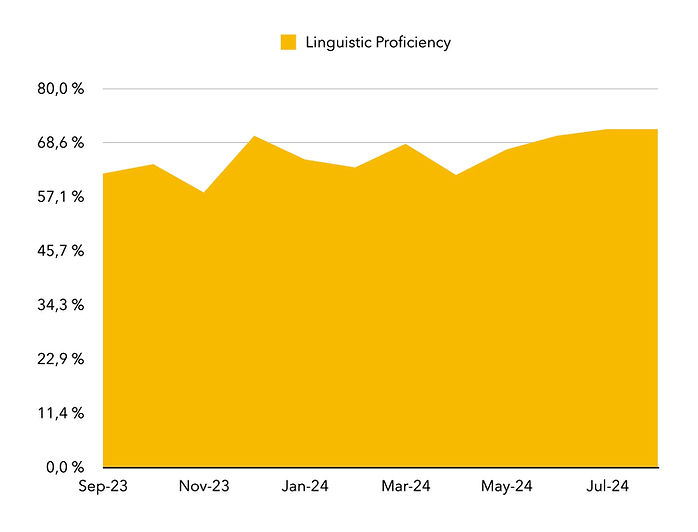
Our research reveals that there has been a relatively stable trend with some fluctuations in the overall linguistic proficiency, ending at around 70% accuracy. There was a noticeable dip in accuracy to about 60% in November, followed by a sharp increase to peak at roughly 72% in December. After this peak, the accuracy level slightly declined and stabilised, hovering between 65% and 70% for the remainder of the period. The trend suggests that while there have been some short-term variations, the overall language skills of these chatbots have remained fairly consistent over the year, with no dramatic long-term improvements or declines. This stability might indicate that the chatbots have reached a certain level of proficiency in language skills, with ongoing refinements and updates helping to maintain this level rather than significantly advancing it.
The exceptional performance of chatbots in tests of Synonym Recognition (100%) and Word Substitution (93%) in August demonstrates their advanced language processing capabilities, which translate into significant benefits for users. This mastery allows chatbots to understand and generate more natural, context-appropriate language, leading to clearer and more effective communication. Users can expect more accurate responses to their queries, with chatbots able to interpret nuanced meanings and provide alternatives when clarification is needed. In content generation tasks, chatbots can produce more varied and engaging text, avoiding repetition by skilfully employing synonyms. This linguistic flexibility also enhances translation capabilities, allowing for more accurate and contextually appropriate renderings across languages. Moreover, such language mastery enables chatbots to better understand and mimic human communication styles, potentially leading to more personalised and natural interactions. For professionals in fields like writing, education, or customer service, these capabilities offer powerful tools for enhancing productivity and improving the quality of their work.
However, the low accuracy rate of chatbots on the Syntactic Organisation Assessment (29%), particularly in word ordering tasks, reveals a significant weakness in their language processing capabilities. This dysfunction likely stems from the fundamental way these AI models process language - they often rely heavily on statistical patterns and correlations rather than a deep understanding of grammatical rules and syntactic structures.
Unlike humans, who internalise complex grammatical rules from a young age, chatbots may struggle to consistently apply these rules, especially in less common or more complex sentence structures. This shortcoming could lead to the generation of awkward, unnatural, or even incomprehensible sentences, particularly when dealing with languages that have flexible word order or complex syntactic rules.
For chatbot users, this presents several risks. Firstly, there's a danger of miscommunication, as incorrectly structured sentences can alter or obscure meaning. In professional or educational contexts, this could lead to errors in important documents or misunderstandings in instructional content. Additionally, for language learners using chatbots as practice tools, exposure to syntactically incorrect language could reinforce errors and impede proper language acquisition. Ultimately, this underscores the importance of human oversight and the need for caution when relying on AI-generated content, especially in contexts where precise language use is crucial.

Verbal Reasoning Accuracy Rate
There has been a general upward trend, starting at around 30% accuracy in September 2023 and reaching approximately 60% accuracy by August 2024. There are some fluctuations in the middle of the period, with a slight dip around April-May 2024, but the overall trajectory is positive. This indicates that the chatbots' performance in Verbal Reasoning tasks has significantly improved over the course of the year. It's noteworthy that chatbots demonstrate higher proficiency in language skills, with an accuracy of 70%, compared to their performance in verbal reasoning tasks. This higher accuracy in Linguistic Proficiency suggests that current AI models are particularly adept at tasks directly related to language processing, understanding, and generation. The superior performance in language skills likely stems from the fundamental design and training of these models, which are built on vast amounts of textual data and are optimised for natural language tasks. In contrast, Verbal Reasoning skills, which often require more complex cognitive processes like deduction, categorisation, and spatial awareness, present a greater challenge for AI systems, as evidenced by the lower (though improving) accuracy shown in the graph.
The high performance of chatbots in Quantitative Analysis and Spatial Awareness tests, with an accuracy of 78.6%, is particularly noteworthy within the context of Verbal Reasoning assessment. This impressive result in Quantitative Analysis demonstrates the chatbots' strong capability to interpret and analyse numerical data, even when presented in complex problem-solving scenarios. It suggests that these AI systems have developed robust algorithms for processing quantitative information, likely due to their extensive training on diverse datasets that include numerical and statistical content. This proficiency indicates that chatbots can effectively bridge the gap between verbal comprehension and mathematical reasoning, a skill that is increasingly valuable in data-driven decision-making processes.
The equally high performance in the Spatial Awareness Test is intriguing, given the test's unique design that combines elements of both Verbal Reasoning and Spatial Awareness. By presenting spatial problems through written descriptions, the test engages multiple cognitive domains simultaneously. The chatbots' success in this area suggests a sophisticated ability to translate verbal descriptions into mental spatial representations, and then manipulate these representations to solve problems. This skill demonstrates not only strong language processing capabilities but also an unexpected aptitude for spatial reasoning when mediated through language. It raises interesting questions about the nature of spatial cognition in AI systems and how it interacts with natural language processing.
In stark contrast, the chatbots' relatively poor performance in the Deductive Reasoning Test, with an accuracy of only 42.9%, reveals a significant gap in their cognitive abilities. This test, designed to assess the capacity to draw logical conclusions from given information, appears to challenge the chatbots in ways that the other tests do not. The lower accuracy suggests that while chatbots excel at processing and analysing explicit information (as seen in the Quantitative and Spatial tests), they struggle with the more abstract task of logical inference. This difficulty in deductive reasoning points to limitations in the chatbots' ability to understand deep logical relationships between ideas, identify implicit patterns, and apply logical rules consistently. It highlights an area where current AI models fall short of human-like reasoning capabilities, particularly in tasks requiring critical analysis and the derivation of valid conclusions from complex sets of premises.


Rational Thinking Accuracy Rate
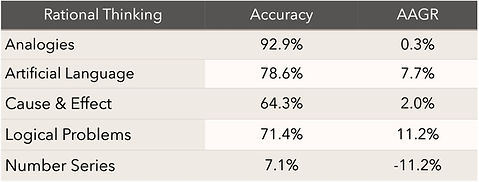
The progression of Rational Thinking skills for a panel of leading chatbots over a 12-month period is illustrated. Starting at around 40% accuracy in September, the trend shows a gradual improvement, culminating in a significant uptick to approximately 63% by August. This upward trajectory, particularly pronounced in the final months, suggests substantial advancements in the chatbots' ability to handle Rational Thinking tasks such as analogies, artificial language, cause and effect reasoning, logical problems, and number series tests. Interestingly, while chatbots demonstrate the highest performance in Language Proficiency with an average accuracy of 70%, their performance in Rational Thinking (63% accuracy) slightly edges out their Verbal Reasoning capabilities (60% accuracy). This hierarchy of skills indicates that while natural language processing remains the chatbots' strong suit, they are making notable strides in more complex cognitive tasks that require logical analysis and pattern recognition. The steady improvement in Rational Thinking skills over the year, particularly the sharp rise towards the end, suggests that AI developers are placing increased emphasis on enhancing these higher-order cognitive abilities, potentially narrowing the gap between Language Proficiency and more abstract reasoning capabilities in AI systems.
That being said, the performance of leading chatbots in Rational Thinking abilities over a 12-month period reveals a striking disparity across different types of cognitive tasks. Most notably, these AI systems demonstrate exceptional prowess in Analogies, achieving an impressive 92.9% accuracy rate. This remarkable performance suggests that chatbots have developed a strong capacity for recognising and applying patterns of relationships between concepts, a fundamental aspect of human-like reasoning. Additionally, the data indicates progress in other areas of Rational Thinking, including Artificial Language comprehension, understanding Cause & Effect relationships, and solving Logical Problems. These advancements point to the ongoing evolution of AI systems in handling complex, abstract reasoning tasks that require nuanced understanding and application of logical principles.
However, the same data set exposes a significant weakness in the chatbots' ability to handle Number Series tests, with an alarmingly low accuracy rate of just 7.1%. Even more concerning is the 11.2% regression in this area over the 12-month period, suggesting a deterioration rather than improvement in numerical pattern recognition and manipulation. This stark contrast between performance in language-based analogies and number-based sequences highlights a critical gap in the current capabilities of AI systems. It underscores the challenges that remain in developing truly well-rounded artificial intelligence that can perform consistently across all aspects of Rational Thinking. The regression in Number Series performance, in particular, raises questions about the stability and generalisability of AI learning in mathematical domains and points to a need for focused improvement in this area.

Numerical Ability Accuracy Rate
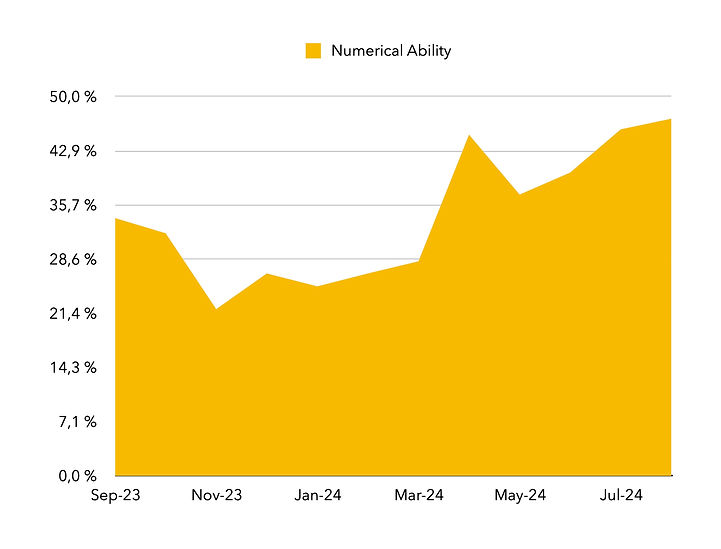
The evolution of numerical ability accuracy for a panel of chatbots over a 12-month period from September 2023 to August 2024 is shown. The trend reveals significant fluctuations, starting around 30% in September 2023, dropping to about 20% in December, then rising dramatically to peak at approximately 45% in May 2024. After a brief dip, it stabilises at around 45% by August 2024. This indicates an overall improvement in Numerical Ability, albeit with considerable variability throughout the year.
Comparing these results to the chatbots' performance in other areas reveals an interesting pattern. The accuracy rates for Linguistic Proficiency (70%), Verbal Reasoning (60%), and Rational Thinking (63%) are notably higher than the peak Numerical Ability accuracy shown in the graph (about 45%). This discrepancy suggests that current AI models excel in language-based and logical reasoning tasks more than in pure numerical computations. The superior performance in language skills likely stems from the fundamental architecture of these models, which are primarily trained on vast amounts of textual data. The relatively strong showing in Verbal Reasoning and Rational Thinking indicates that these chatbots have developed robust capabilities in processing and analysing information presented in natural language formats. However, the lower accuracy in Numerical Ability points to an area where these AI systems still face challenges, possibly due to the more abstract and precise nature of mathematical operations and concepts. This disparity highlights potential areas for improvement in AI development, particularly in enhancing numerical processing capabilities to match the strong performance observed in language-related tasks.
The performance of chatbots in Statistical Reasoning tests is impressive, with an accuracy rate of 85.7% and a consistent monthly improvement of 3.0%. This high level of proficiency suggests that AI models have developed a strong capability to understand and interpret statistical concepts, analyse data patterns, and draw insights from numerical information. The steady progression indicates that these systems are continuously improving their ability to handle complex statistical problems. This proficiency likely stems from the vast amount of data these models are trained on, which often includes statistical information and patterns. The high performance in this area suggests that chatbots could be particularly useful in data analysis, research interpretation, and decision-making processes that rely on statistical reasoning.
However, the performance of chatbots in the Order & Fraction Mathematics test presents a stark contrast, with a low accuracy rate of 21.4% and a concerning monthly regression of 0.6%. This poor performance suggests significant difficulties in handling mathematical operations involving fractions and ordering of numbers. The regression over time is particularly worrying, as it indicates that current training methods may not be effectively addressing this weakness. This struggle with fractions and ordering could stem from the more abstract nature of these concepts, which might not be as well-represented in the natural language data these models are primarily trained on. The poor performance in this area highlights a critical gap in the mathematical capabilities of current AI systems.
The most alarming result is in Time-Related Calculations, where chatbots show a 0.0% accuracy rate with no improvement over time. This complete failure in performing time-related calculations is surprising, especially given the relatively strong performance in Temporal Mathematics. It suggests a fundamental inability to perform even basic arithmetic operations involving time units. This could indicate a severe limitation in the AI models' ability to manipulate and calculate with time-specific data, despite being able to understand temporal concepts in a more abstract sense. The lack of any improvement over time in this area is particularly concerning and points to a critical blind spot in the current development of AI mathematical capabilities. This glaring weakness could significantly limit the practical applications of these chatbots in scenarios requiring precise time-based calculations.

Chatbots’ Progress in Comparative Perspective
Linguistic Proficiency Evolution
Claude demonstrates exceptional linguistic capabilities, achieving a 90% accuracy rate in overall Linguistic Proficiency. This places Claude at the top of the evaluated chatbots, surpassing both ChatGPT-3.5 (60%) and ChatGPT-4o (80%). Claude's performance is particularly impressive considering its 3.1% improvement over the 12-month period, indicating consistent enhancement of its linguistic abilities. In contrast, Gemini, despite matching ChatGPT-4o's 80% accuracy, showed a concerning 2.6% regression in its skills. Co-Pilot and HuggingChat also achieved 80% accuracy, while Replika lagged behind at 50% despite showing the highest improvement rate of 8%.
Antonym Recognition. In Antonym Recognition, Claude maintained a perfect 100% accuracy, on par with ChatGPT-4o, Co-Pilot, and HuggingChat. This skill remained stable for Claude over the 12-month period, showing no change. Interestingly, Replika, despite starting from a lower base of 50% accuracy, demonstrated the most significant improvement with a 24.2% increase. Gemini, however, experienced a 6.1% decline in this area, dropping to 50% accuracy and aligning with ChatGPT-3.5's performance.
Language Comprehension. Claude excelled in Language Comprehension, being the only chatbot to achieve 100% accuracy. More impressively, it showed a substantial 33.3% improvement over the year, indicating rapid learning and adaptation in this crucial area. In comparison, ChatGPT-3.5, ChatGPT-4o, Gemini, and HuggingChat all scored 50%. Notably, Co-Pilot experienced a 12.1% decline in this skill, while Gemini regressed by 6.1%. Replika, starting from a lower base, showed promising growth with a 12.1% improvement.
Word Substitution. In Word Substitution, Claude maintained a perfect 100% accuracy, matching the performance of most other advanced chatbots including ChatGPT-3.5, ChatGPT-4o, Co-Pilot, Gemini, and HuggingChat. There was no change in performance for any of these chatbots over the 12-month period, suggesting this skill may have reached a ceiling for current AI technologies. Replika was the only outlier, scoring 50% in this category.
Syntactic Organisation. Claude demonstrated competence in Syntactic Organisation with a 50% accuracy rate, on par with ChatGPT-4o, Co-Pilot, and HuggingChat. However, Claude showed no improvement in this area over the 12-month period, unlike ChatGPT-4o which saw a significant 66.7% increase. Co-Pilot also improved by 18.2%. Gemini's performance in this area was particularly concerning, with an 18.2% decline, dropping to 0% accuracy alongside ChatGPT-3.5 and Replika.
Synonym Recognition. In Synonym Recognition, Claude maintained a perfect 100% accuracy, matching all other chatbots except Replika. Interestingly, while Claude's performance remained stable, Gemini, HuggingChat, and Replika all showed a 6.1% improvement in this area. This suggests that while Claude's performance is excellent, there might be room for further refinement or expansion of its synonym database.
Verbal Reasoning Evolution
When examining the Verbal Reasoning capability of Co-Pilot, the data paints a promising picture. While the actual accuracy levels indicate that Co-Pilot performs on par with ChatGPT-3.5, Claude, and Gemini at 70% across the Verbal Reasoning domain, the average percentage changes over a 12-month period reveal that Co-Pilot has the highest rate of progression among these chatbots.
Specifically, Co-Pilot's Verbal Reasoning capability has increased by 10.6% on average over the past year. This is a significantly higher rate of progression compared to ChatGPT-3.5 (5.2%), Claude (4.1%), and Gemini (0.9%). Even more notable is the fact that ChatGPT-4o has seen a regression in its Verbal Reasoning capability, with a -5.1% average decrease over the same period.
Word Categorisation. All the chatbots included in the comparison have the same level of accuracy at 50% for the Word Categorisation skill set. When examining the progress over a 12-month period, the average percentage change for the Word Categorisation skill set is 0% across all the chatbots, except for Replika, which has seen an 18.2% increase. The lack of progress in Word Categorisation across the majority of the chatbots suggests that this may be a relatively stable and well-developed capability, at least in the context of the current testing and evaluation framework. However, the consistent 50% accuracy level also indicates that there is room for further improvement and refinement of this skill set, which could potentially benefit the overall Verbal Reasoning performance of the chatbots.
Deductive Reasoning. Most chatbots have a 50% accuracy level in Deductive Reasoning. The exception is HuggingChat, which has a 0% accuracy level in this skill set. ChatGPT-3.5 and Gemini have both experienced an 18.2% increase in their Deductive Reasoning performance. Claude has seen a 25% improvement in this skill set. However, Co-Pilot and HuggingChat have not shown any progress (0% change) in Deductive Reasoning over the past year. Replika has seen a 24.2% increase in its Deductive Reasoning capabilities. The data suggests that while most chatbots maintain a 50% accuracy level in Deductive Reasoning, some (ChatGPT-3.5, Gemini, Claude, Replika) have been able to improve this skill set more than others (Co-Pilot, HuggingChat). The significant 25% improvement for Claude is particularly noteworthy, as it indicates that this chatbot has made substantial advancements in its ability to engage in logical, deductive reasoning. This could be a valuable capability for tasks that require complex problem-solving and decision-making. The lack of progress for Co-Pilot and HuggingChat in this area suggests that Deductive Reasoning may be a skill set that requires more targeted development and refinement for these chatbots. Improving their Deductive Reasoning capabilities could enhance their overall Verbal Reasoning performance and make them more versatile in problem-solving and analytical tasks.
Linguistic Cohesion. Claude stands out with a 100% accuracy level, while the other chatbots (ChatGPT-3.5, ChatGPT-4o, Co-Pilot, Gemini, HuggingChat) all have a 50% accuracy level. Replika, on the other hand, has a 0% accuracy level for Linguistic Cohesion. This indicates that Claude is highly proficient in producing coherent, well-connected, and logically structured language output. Meanwhile, HuggingChat has demonstrated a promising 18.2% increase in its Linguistic Cohesion performance over the past 12 months. This suggests that HuggingChat is making improvements in its ability to generate linguistically cohesive and coherent responses, which could enhance its overall Verbal Reasoning capabilities.
Quantitative Analysis. The ability to effectively handle numerical reasoning, calculations, and problem-solving is crucial for chatbots, particularly in domains such as financial analysis, data-driven decision-making, and technical problem-solving. ChatGPT-3.5, ChatGPT-4o, Co-Pilot, Gemini, and HuggingChat all have an impressive 100% accuracy level in Quantitative Analysis, indicating excellent capabilities in this domain. Claude has a 50% accuracy level, which is still relatively strong but lags behind the top-performing chatbots. Replika, on the other hand, has a 0% accuracy level in Quantitative Analysis, suggesting significant limitations in its numerical reasoning abilities.
ChatGPT-4o, and Co-Pilot have maintained their high 100% accuracy levels, with no change (0%) in their Quantitative Analysis performance over the 12-month period. Claude has remained stable at a 50% accuracy level, with no change (0%) in its Quantitative Analysis performance. Co-Pilot and HuggingChat, on the other hand, have seen a remarkable 24.2% improvement. Gemini has seen a concerning -12.1% decline, and Replika has experienced an -18.2% decline, further highlighting the struggles in this domain.
Spatial Awareness. ChatGPT-3.5, Claude, Co-Pilot, and Gemini all have a strong 100% accuracy level in Spatial Awareness, indicating excellent capabilities in this domain. ChatGPT-4o, HuggingChat and Replika have a 50% accuracy level, suggesting more limited spatial reasoning abilities. HuggingChat has seen a 24.2% improvement, while ChatGPT-4o has experienced a significant -22.2% decline. ChatGPT-4o's decline and HuggingChat's improvement demonstrate the variable nature of performance in this skill set. The ability to effectively handle spatial reasoning, visual pattern recognition, and geometric concepts is crucial for chatbots, particularly in domains such as design, engineering, architecture, and data visualisation. The wide range of performance observed across the chatbots highlights the importance of continued research and development to improve their Spatial Awareness capabilities. It's worth noting that Spatial Awareness is often considered a more specialised skill set compared to broader linguistic and reasoning abilities. The variations in performance among the chatbots suggest that developing robust spatial reasoning capabilities may require dedicated focus and optimisation efforts.
Rational Thinking Evolution
ChatGPT 3.5 demonstrates strong performance in Rational Thinking capability, maintaining an 80% accuracy rate, comparable to both Claude and Co-Pilot, and significantly higher than other chatbots like Gemini, HuggingChat, and Replika. In analysing the five skills, ChatGPT 3.5 has maintained perfect accuracy in four out of the five categories: Analogies, Artificial Language, Cause & Effect, and Logical Problems. Additionally, what distinguishes ChatGPT 3.5 is its exceptional rate of progression, which is the highest among all compared models at 6.3% over a 12-month period. This high rate of improvement suggests that ChatGPT 3.5 is rapidly enhancing its capabilities in Rational Thinking, positioning it as a more promising tool over time.
Analogies. When examining the performance of chatbots on Analogies, we see a consistent and impressive pattern across most of the major AI models. ChatGPT-3.5, ChatGPT-4o, Claude, Co-Pilot, Gemini, and HuggingChat all achieved a perfect 100% accuracy score on Analogies tasks. This demonstrates a high level of proficiency in understanding and manipulating abstract relationships between concepts, which is a key component of analogical reasoning. The only outlier in this category is Replika, which scored 50% accuracy, significantly lower than its peers. Interestingly, when we look at the percentage change data, we see that most chatbots maintained their high performance, showing 0% change. This suggests that their capabilities in handling analogies were already well-developed and remained stable. The exception is Claude, which showed an 8.3% improvement, indicating that it enhanced its already strong performance in this area. Overall, the data suggests that analogical reasoning is a strong suit for most advanced AI language models, with near-perfect performance being the norm rather than the exception.
Artificial Language. The most notable progress is seen in Artificial Language, where ChatGPT 3.5 has achieved a remarkable 24.2% improvement, surpassing all other chatbots, including the advanced ChatGPT-4o, which only improved by 22.2%. This indicates that ChatGPT 3.5 is not only accurate but also quickly adapting and improving its understanding of complex language structures, making it a powerful tool for tasks requiring nuanced language interpretation.
Cause & Effect. When comparing ChatGPT 3.5 to other models, it stands out in its consistency across most skills. For instance, it retains a 100% accuracy in Cause & Effect, which is also shared by Claude, but contrasts with Co-Pilot, which has seen a decline of 6.1% in this area. This decline in Co-Pilot’s performance could be a concern for users needing consistent and reliable causal reasoning.
Logical Problems. Moreover, ChatGPT 3.5’s stability in skills like Logical Problems, where it has not only maintained 100% accuracy but also showed a 6.1% improvement, further solidifies its standing as a reliable choice for logical reasoning tasks.
Number Series. Despite its strengths, ChatGPT 3.5 does have a notable weakness in the Number Series skill, where it, along with most other models except Co-Pilot, fails to show any accuracy. Co-Pilot, with a 50% accuracy in Number Series, is the only chatbot that has demonstrated any capability in this area, although it has not shown any improvement. This unique strength of Co-Pilot might influence users who prioritise numerical reasoning in their decision-making processes to prefer Co-Pilot over ChatGPT 3.5, despite the latter’s overall superior progress in Rational Thinking.
Numerical Ability Evolution
ChatGPT-3.5 demonstrates the highest overall Numerical Ability among the compared models, with an impressive 80% accuracy and a positive growth trend of 6.3% over the 12-month period. ChatGPT-4o follows closely with 70% accuracy and a 5.6% growth rate. Both models significantly outperform Gemini (30%), HuggingChat (30%), Co-Pilot (50%), and Replika (10%) in terms of accuracy. Claude shows promising growth at 8.5%, reaching 60% accuracy. This indicates that the ChatGPT models are currently leading in numerical capabilities, with Claude showing potential to catch up.
Temporal Mathematics. Both ChatGPT-3.5 and ChatGPT-4o excel in Temporal Mathematics with perfect 100% accuracy, matching Co-Pilot and Claude. Their growth rate remains at 0%, suggesting they’ve maintained the top performance consistently. Gemini shows a concerning decline of -24.2%, while HuggingChat and Replika show improvements of 18.2% each, though starting from lower baselines. This indicates that while the ChatGPT models are top performers in this area, other models are making strides to catch up.
Order & Fraction Mathematics. ChatGPT-3.5 stands out in this category with 100% accuracy and substantial growth of 24.2%. In contrast, ChatGPT-4o shows lower accuracy at 50% and a notable decline of -22.2%, indicating a potential area for improvement. Both models outperform their competitors, with Gemini being the only other model showing any proficiency (0% accuracy but 6.1% growth). The stark difference between ChatGPT-3.5 and ChatGPT-4o in this area is particularly noteworthy and may warrant further investigation.
Spatial Reasoning. Both ChatGPT models achieve 100% accuracy in Spatial Reasoning, with ChatGPT-3.5 showing 18.2% growth and ChatGPT-4o demonstrating even stronger improvement at 22.2%. They outperform Gemini (50% accuracy, -6.1% growth) and Co-Pilot (50% accuracy, 0% growth), while significantly surpassing HuggingChat and Replika (both at 0% accuracy). Claude matches their 100% accuracy with a modest 8.3% growth. This indicates a strong performance across the board for the top-performing models in this skill set.
Statistical Reasoning. ChatGPT-3.5 and ChatGPT-4o both achieve perfect 100% accuracy in Statistical Reasoning, matching the performance of Gemini, HuggingChat, Co-Pilot, and Claude. However, both ChatGPT models show no growth in this area. In contrast, HuggingChat and Co-Pilot demonstrate improvement with 12.1% growth each, while Claude shows the most significant progress with a 33.3% increase. This suggests that while the ChatGPT models are performing at peak levels, competitors are rapidly improving and may soon challenge their dominance in this area.
Time-Related Calculations. Surprisingly, all models, including ChatGPT-3.5 and ChatGPT-4o, show 0% accuracy and 0% growth in Time-Related Calculations. This uniform poor performance suggests a significant gap in capabilities across all tested AI models or potential issues with the testing methodology for this specific skill set. It's clearly an area that requires focused development efforts across the board.

Accuracy Rates for a panel of prominent chatbots in August 2024.

Change in Accuracy Rates for a panel of prominent chatbots over a 12-month period.
Chatbots as Strategic Tools in Business
Claude’s Linguistic Proficiency
Claude's exceptional Linguistic Proficiency has the potential to revolutionise business education and decision-making processes for strategic and operational managers. Its high accuracy in language comprehension and word-related tasks makes it an invaluable asset in various business contexts. In the realm of business education, Claude can serve as an advanced learning tool, helping managers and students alike to refine their language skills and grasp complex business concepts more effectively. Its ability to process and analyse vast amounts of textual data can aid in the creation of more comprehensive and nuanced case studies, market reports, and industry analyses. This can lead to more informed decision-making processes, as managers would have access to deeper, more nuanced insights derived from a wide array of linguistic sources.
The benefits of leveraging Claude's Linguistic Proficiency in business operations are multifaceted. Enhanced accuracy in document analysis can significantly improve the efficiency and effectiveness of contract reviews, policy interpretations, and regulatory compliance checks. This could potentially save businesses substantial time and resources while minimising legal risks. Improved communication clarity facilitated by Claude can lead to more effective internal and external communications, potentially reducing misunderstandings and conflicts within teams and with stakeholders. The potential time savings in language-related tasks, such as drafting reports, preparing presentations, or translating documents, could allow managers to focus more on strategic thinking and high-value activities. Claude's strong performance in antonym and synonym recognition could be particularly advantageous in crafting nuanced marketing messages, enabling businesses to fine-tune their brand voice and resonate more effectively with target audiences. Similarly, this capability could be instrumental in interpreting competitor communications, providing businesses with a sharper edge in competitive intelligence and market positioning.
However, it is crucial to acknowledge and address the potential risks associated with relying on AI like Claude for linguistic tasks in business contexts. Despite Claude's high overall performance, its 50% accuracy in Syntactic Organisation highlights a significant limitation. This suggests potential difficulties in understanding or generating complex sentence structures, which could lead to critical misinterpretations in high-stakes business scenarios. For instance, in legal document analysis, contract negotiations, or international business communications where nuanced language is crucial, these limitations could result in costly misunderstandings or legal complications. Managers must be acutely aware of this limitation and implement robust verification processes to ensure the accuracy of AI-generated or AI-interpreted complex linguistic structures.
Moreover, the risk of over-reliance on AI for linguistic tasks is a pressing concern that businesses must address proactively. While Claude's capabilities are impressive, excessive dependence on AI could potentially lead to a decline in human language skills within an organisation. This could result in a workforce less capable of critical thinking, nuanced communication, and creative expression – all of which are essential in today's complex business environment. To mitigate this risk, organisations should implement strategies that balance AI utilisation with continued development of human linguistic skills. This could involve regular language training programs, encouraging employees to engage in diverse reading and writing activities, and fostering a culture that values human creativity and expression alongside technological efficiency.
It's also paramount for managers to recognise that while Claude's performance is impressive, it is not infallible. Human oversight remains crucial, especially in high-stakes business decisions or communications. AI models, including Claude, can exhibit biases or make errors that may not be immediately apparent. Therefore, a robust system of human checks and balances should be implemented when using AI for important linguistic tasks. This could involve having human experts review AI-generated content, cross-referencing AI interpretations with human understanding, and regularly auditing AI performance in various linguistic tasks.
Co-Pilot’s Verbal Reasoning
Co-Pilot's remarkable advancement in Deductive Reasoning, with a 25% increase in accuracy over the past year, represents a significant leap forward in AI capabilities that could revolutionise complex problem-solving and strategic decision-making in business contexts. This substantial improvement positions Co-Pilot as a powerful tool for both business education and organisational management. In educational settings, Co-Pilot could be used to create sophisticated, multi-layered business simulations that challenge students to apply Deductive Reasoning to complex, real-world scenarios. These simulations could mimic the intricacies of global markets, supply chain disruptions, or competitive strategy formulation, providing students with a safe environment to hone their decision-making skills. For business schools, integrating Co-Pilot into their curriculum could lead to more engaging, interactive learning experiences that better prepare students for the complexities of modern business landscapes.
In organisational management, Co-Pilot's enhanced Deductive Reasoning capabilities could be leveraged to analyse vast amounts of business data and draw logical conclusions, assisting executives in making more informed strategic decisions. For instance, it could help identify subtle market trends, predict potential outcomes of different strategic moves, or uncover hidden relationships between seemingly unrelated business factors. This could be particularly valuable in industries characterised by rapid change and high complexity, such as technology, finance, or healthcare, where the ability to quickly and accurately deduce insights from large datasets can provide a significant competitive advantage.
The simultaneous improvements in Quantitative Analysis (24.2% increase) and Spatial Awareness (18.2% increase) further amplify Co-Pilot's potential impact on business operations. The enhancement in Quantitative Analysis suggests that Co-Pilot has become more adept at processing and interpreting numerical data, which is crucial for financial modelling, market analysis, and performance metrics evaluation. This could lead to more accurate financial forecasts, better risk assessments, and more efficient resource allocation within organisations. The improved Spatial Awareness, on the other hand, could be particularly beneficial in areas such as supply chain optimisation, store layout planning in retail, or even in virtual reality applications for business, such as immersive data visualisation or virtual product design.
However, it is crucial to approach the integration of Co-Pilot's capabilities with careful consideration of potential risks and limitations. While the data suggests a positive trajectory in its skills development, the long-term reliability and robustness of these capabilities must be rigorously evaluated. Organisations should implement comprehensive testing protocols to regularly assess Co-Pilot's performance across various business scenarios, ensuring its outputs remain accurate and relevant as business contexts evolve.
One significant concern is the potential for biases or inconsistencies in Co-Pilot's outputs. AI systems can inadvertently perpetuate or amplify existing biases present in their training data, which could lead to skewed analysis or recommendations. This is particularly critical in areas such as hiring decisions, customer segmentation, or financial risk assessment, where biased outputs could have serious ethical and legal implications. Organisations must implement robust bias detection and mitigation strategies, potentially including diverse human oversight teams to review and validate Co-Pilot's outputs in sensitive areas.
Another consideration is the risk of over-reliance on AI-generated insights, potentially leading to a decline in human critical thinking and decision-making skills within the organisation. While Co-Pilot can process and analyse vast amounts of data quickly, it lacks the contextual understanding, emotional intelligence, and ethical judgment that human managers bring to complex business decisions. Organisations should strive to use Co-Pilot as a complement to human intelligence rather than a replacement, fostering a collaborative approach where AI insights inform, but do not dictate, human decision-making.
Data security and privacy concerns also need to be carefully addressed when integrating Co-Pilot into business processes. As the AI system processes sensitive business information, robust cybersecurity measures must be in place to protect against data breaches or unauthorised access. Additionally, clear policies should be established regarding data ownership, usage, and retention, especially when dealing with customer or employee data.
To mitigate these risks and harness the full potential of Co-Pilot's capabilities, organisations should implement comprehensive governance frameworks. This could include establishing clear guidelines for when and how Co-Pilot should be used in decision-making processes, regular audits of its performance and outputs, and ongoing training for employees on how to effectively collaborate with and critically evaluate AI-generated insights.
Moreover, organisations should invest in developing their employees' skills to work alongside AI systems like Co-Pilot. This could involve training programs that focus on enhancing human skills that complement AI capabilities, such as emotional intelligence, creative problem-solving, and ethical decision-making. By fostering a workforce that can effectively leverage AI tools while maintaining strong human judgment, organisations can create a powerful synergy between artificial and human intelligence.
ChatGPT’s Rational Thinking & Numerical Ability
The evolution of ChatGPT 3.5 marks a significant milestone in the development of AI, particularly in its rapidly improving Rational Thinking skills, which have profound implications for business education and decision-making. As organisations increasingly turn to AI to support their strategic and operational activities, ChatGPT 3.5’s robust performance across a wide array of cognitive tasks positions it as a highly valuable tool. For strategic and operational managers, the ability of ChatGPT 3.5 to process complex information, provide insights grounded in sophisticated logical reasoning, and adapt quickly to new information can greatly enhance the decision-making process. These capabilities allow the AI to contribute to tasks such as scenario planning, risk assessment, and strategic forecasting, where Rational Thinking is paramount. By integrating ChatGPT 3.5 into their decision-making frameworks, managers can potentially reduce cognitive biases, enhance the rigour of their analyses, and make more informed decisions that align with both short-term operational goals and long-term strategic objectives.
The choice between ChatGPT 3.5 and other AI tools, such as Co-Pilot, hinges on a nuanced understanding of the strengths and weaknesses of each model in relation to the specific needs of the user. While ChatGPT 3.5 excels in language-based reasoning, making it ideal for tasks that require nuanced interpretation of textual information or complex logical deductions, Co-Pilot’s distinct competence in Number Series might make it more suitable for scenarios where numerical pattern recognition and sequence analysis are critical. For instance, in financial modelling or algorithmic trading, where numerical data often needs to be interpreted in specific sequences, Co-Pilot might have an edge. However, for broader strategic and operational applications that require integrating various forms of data—numerical, textual, and contextual—ChatGPT 3.5's well-rounded cognitive abilities could offer more comprehensive support. Thus, organisations and educational institutions must carefully assess their specific needs and contexts when deciding which AI model to integrate into their workflows.
Furthermore, the strong Numerical Ability exhibited by ChatGPT models, particularly ChatGPT 3.5, offers significant advantages for both business education and organisational decision-making. In the realm of business education, these AI models can serve as invaluable tools for teaching complex quantitative skills, such as data analysis, financial modelling, and statistical interpretation. The AI's proficiency in these areas allows it to act as a 24/7 tutor for business students, helping them understand and apply numerical concepts in real-world scenarios. For organisations, the ability of ChatGPT 3.5 to quickly and accurately analyse large datasets, identify trends, and provide actionable insights can enhance the quality and speed of strategic and operational decisions. For example, its strong performance in Statistical Reasoning and Spatial Reasoning enables it to assist managers in identifying correlations, forecasting outcomes, and optimising resources. Moreover, the AI’s competence in Order & Fraction Mathematics can support more accurate financial projections and budgeting, thereby improving financial stability and planning within organisations. However, while these benefits are substantial, they must be balanced against the risks of over-reliance on AI, the potential for misinterpreting AI-generated results, and the inherent limitations of these models in certain areas, such as Time-Related Calculations.
Despite the impressive capabilities of AI in numerical reasoning, managers must remain vigilant about the potential downsides of over-reliance on these tools. One significant concern is that the increasing use of AI for numerical analysis could lead to a gradual decline in managers' own analytical skills, as they might become overly dependent on the AI’s capabilities. This dependency could be detrimental in situations where human intuition, experience, and contextual understanding are crucial for interpreting data and making sound decisions. Moreover, while AI models like ChatGPT 3.5 generally demonstrate high accuracy, there is always a risk of errors or misinterpretations, particularly in complex or ambiguous business contexts where the nuances of human judgment play a critical role. The relatively poor performance of these models in Time-Related Calculations also highlights a specific limitation that could have serious implications for scheduling, project management, and time-sensitive financial decisions. Errors in these areas could lead to significant setbacks, financial losses, or missed opportunities. Additionally, the use of AI in decision-making processes raises important ethical and practical questions about accountability and transparency. In high-stakes business environments, the decision-making process must be clear and justifiable, and the reliance on AI must be carefully managed to ensure that it complements, rather than replaces, human judgment. Organisations should view AI as a powerful tool to enhance decision-making, but not as a substitute for the critical thinking and expertise that human managers bring to the table.
Reflective & Practical Questions
Corporate Strategy
Given the research finding that Claude has achieved the highest overall accuracy and growth rate among its competitors, how should companies developing chatbots like Claude strategically allocate resources to sustain and further enhance their competitive edge ? Specifically, how can these companies balance investment in current strengths—such as accuracy and performance—while also identifying and capitalising on new areas of innovation to maintain their leadership in a rapidly evolving market ?
Marketing & Sales Strategy
How should companies developing chatbots, like ChatGPT, adjust their Marketing and Sales Strategy to effectively manage customer expectations and perceptions when free versions occasionally outperform paid versions, and how can they communicate the value of premium offerings in a way that justifies the cost despite this paradox ?
AI Literacy
In light of the research finding that chatbots have a 40% margin of error, how should educational and training institutions design curricula to effectively equip trainees with the critical thinking and digital literacy skills needed to navigate AI-generated information ? Specifically, what strategies can be implemented to teach trainees to recognise the limitations of chatbots, verify information from multiple sources, and know when to seek human expertise, ensuring they can make informed decisions in an increasingly AI-driven world ?